
The Red Bag
On mortality, preparedness, and refusing to be helpless when someone needs help.
Last week I was thinking about what we owe one another when something goes terribly wrong, and whether a small chance of helping is enough to prepare for the worst.
I was on my Tenere 700, riding to the grocery store, when a random person came up and started talking to me about my bike. The questions were familiar. What upgrades had I done? How long had I been riding? Had I been on any recent trips? It happens just about every time I go out.
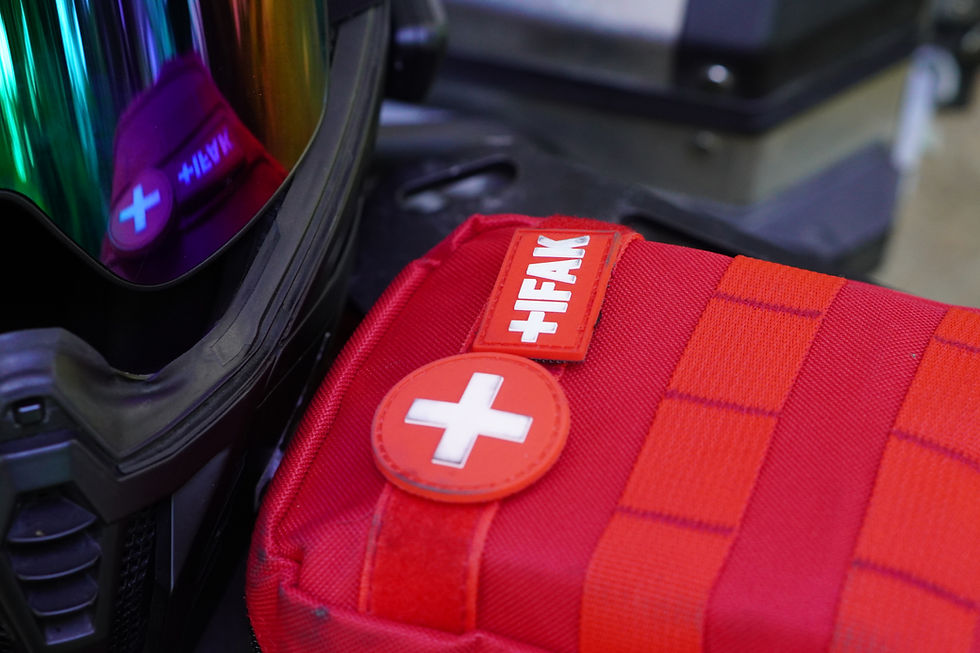
Something had caught their eye. It wasn't the pink stuffed dragon toy, Austin, shoved between my windscreen and navigation system. It was the red MOLLE pouch snapped onto the outside of one of my panniers.
"Is that your first aid kit? Do you always ride with it?" he asked, pointing at the bright red bag, about the size of two stacked paperback novels. A small white cross and the letters IFAK were printed across the top.
"No. That's my IFAK. It's a fast-action trauma response kit."
I reached back, unsnapped it from its mount, and opened it up. Inside were a tourniquet, gauze, trauma shears, and a few other things.
"I have this for when stuff goes really bad."
"Aren't you afraid someone is going to steal it?"
"I have it where everyone can see it if they need it. I'd rather have the potential of someone stealing it than have to dig to find it when I need it."
Death is a Game We Will Always Lose, But Maybe We Can Stall....
Death is inevitable. At some point, it is coming for all of us, and there is no stopping it. But if there is a chance I can help someone, I am going to try, even when I know the odds are against me.
I've been there before.
I've held the hand of the dying, people I knew closely and people who were strangers. I've watched someone bleed out. I've handled bodies of the deceased shortly after the lights turned off. It isn't the act of dying that left the scars on my heart. It is the helplessness surrounding it. Not being able to hold death at bay has left its marks, silent tombstones scattered throughout my memory.
When I was younger, I was traveling across the state with my mom when we came upon an accident. A semi truck carrying a load of hay had twisted and flipped, smashing into several cars. One of the cars had lost its entire top. I don't know how else to describe it. It looked flat without being flattened.
Other cars were smashed and dented along the road.
My mom and I were nearly the first people on the scene. She was a doctor, and she immediately went into action. I stayed in the car as I had been instructed to do. I must have been nine or ten years old. I don't remember much of what happened after that. What I remember is sitting there while my mother walked toward the wreck.
Someone was out there doing something.
I wasn't.
I could only sit and watch while someone else had the skills to help.
I've thought about that accident many times over the years. Maybe because it was one of my earliest lessons in the difference between witnessing something terrible and being prepared to respond to it.
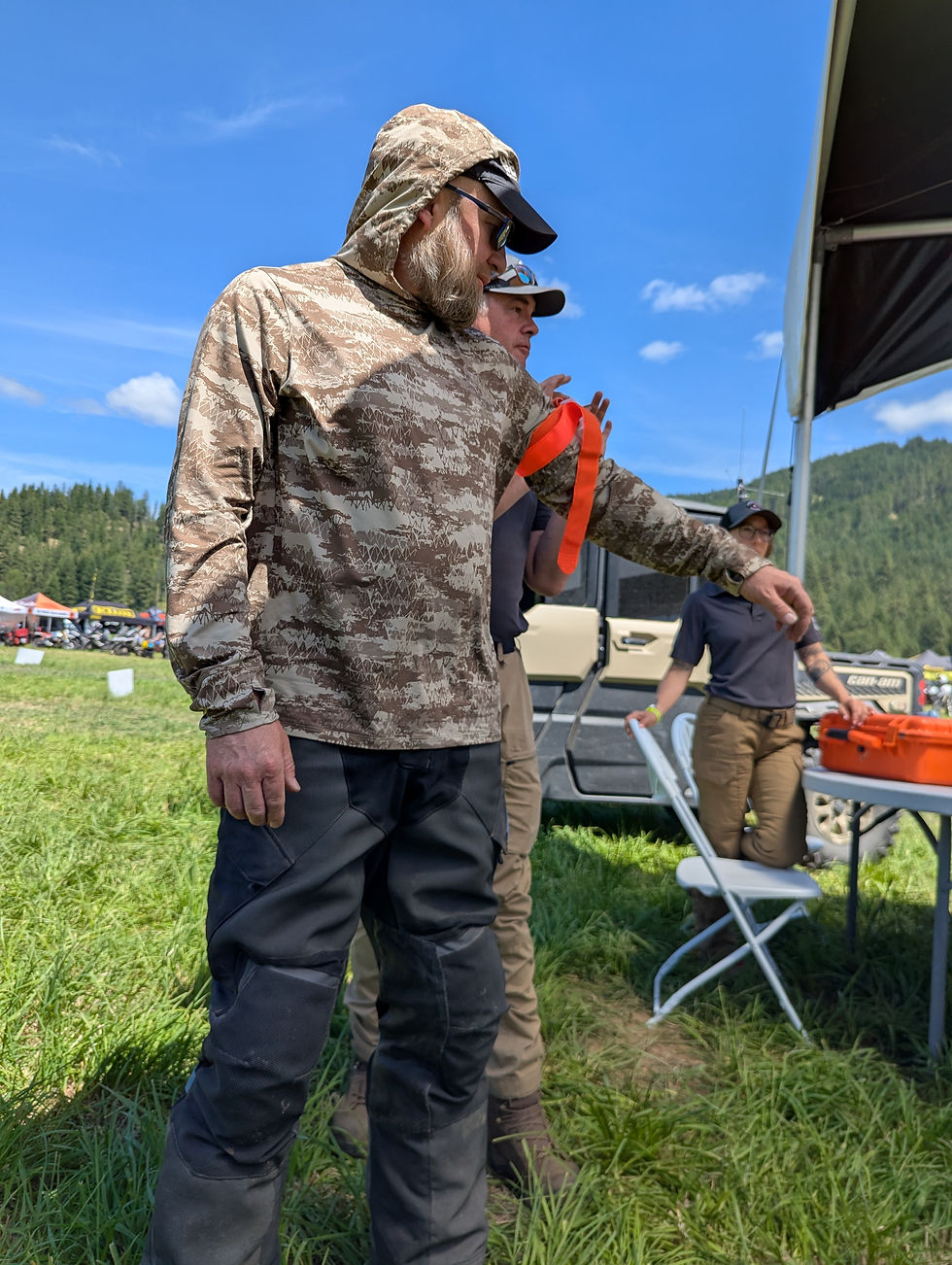
Last year, I went to a training camp for motorcycle expeditions. We spent the week learning the practical skills required to travel long distances on motorcycles: riding, maintenance, repairs, navigation, and everything else that becomes important when you're far from home. One of the courses focused specifically on responding to motorcycle accidents, particularly the kinds of injuries we might encounter while riding off-road in a foreign country. Out there, help may be hours away. When professional help is that far away, what happens in the first few minutes can matter enormously.
But knowing what to do on paper is different from doing it when someone is bleeding in front of you.
After the informational portion of the course, we spent the rest of the week practicing. The situations were staged, but the response wasn't. We'd be walking along when someone was suddenly told, "They're bleeding out from their leg," and handed a tourniquet. We'd come around a corner on our motorcycles and find a rider down in the grass, not moving, beside an overturned bike. The point wasn't to see if we could remember the steps in a classroom. It was to make the response familiar enough that, when something went wrong, we could act before fear and confusion had time to take over.
It was uncomfortable in exactly the way practice should be.
Twins In Trauma Response
I think of trauma response as having a kind of mental partnership. One part is knowledge and experience. The other is preparation.
You can have all the medical knowledge in the world, but if you aren't prepared to use it immediately, that knowledge may not be enough. The same is true of equipment. A well-stocked first aid kit doesn't help much if you don't know what is inside it or how to use it.
Most years I take a medical training or accident-response course in addition to my regular training and duties with Search and Rescue. But training isn't the same thing as practice, and practice is the part I see people forget.
When was the last time you pulled out a tourniquet and practiced applying it? When was the last time you bandaged a wound? When was the last time you thought about scene awareness or practiced CPR?
Knowing what to do is one thing.
Being able to do it when your heart is pounding is another.
But what is an IFAK?
In short, it stands for Individual First Aid Kit. I've never really liked that description. To me, it's more of an "OH-FUCK" kit. Some people call it a trauma response kit. Others call it a STOP THE BLEED kit.
Whatever you call it, this isn't meant to replace a traditional first aid kit. My first aid kit is where I go when someone has a headache, needs a Band-Aid, gets a bee sting, needs antiseptic, or has some other problem that falls under ordinary first aid.
The IFAK is for when ordinary first aid isn't enough.

It is a small, specialized trauma-response pack intended for severe injuries, particularly catastrophic bleeding. The idea is to keep the essentials compact and immediately accessible, so you aren't fumbling through a larger bag when seconds count.
A standard IFAK might contain:
Tourniquet
Hemostatic gauze
Chest seals
Pressure or Israeli bandage
Gloves
Trauma shears
Mine contains:
CAT tourniquet
QuikClot hemostatic gauze
Israeli bandage
Trauma shears
CPR face shield
Chest seal
SAM splint
Nitrile gloves
Tape and Sharpie
I also carry a more comprehensive first aid kit with things such as suture kits and Narcan. The distinction matters because an IFAK isn't meant to contain everything you might possibly need. It is meant to contain what you are most likely to need quickly.

Why do I carry one?
Because the statistics surrounding traumatic bleeding are sobering, particularly when you consider the severity of an injury and the time it can take to reach definitive medical care. Depending on the metrics, scenario, and location, survivability in cases of hemorrhagic trauma can be significantly affected by immediate pre-hospital care, such as applying a tourniquet or pressure bandage.
I don't ride a motorcycle because I think it is safe.
I ride knowing that it isn't.
My preferred places to ride are often off-road, remote, and sometimes far from anyone else. I accept that risk, but accepting risk doesn't mean ignoring it. I try to mitigate it by paying attention to my surroundings, my skill level, the conditions, the motorcycle, the route, and the things that could go wrong.
Risk awareness and mitigation are things I have trained in through different jobs and responsibilities. They are also central to the work I do now. At this point, thinking about risk is almost as natural as thinking about what I would do if someone were injured. So far, I haven't had to use my IFAK. I'm grateful for that. But it has opened a lot of conversations. I've talked with people who don't carry one yet. I've talked with people who have their own version. And those conversations have reminded me that there isn't one universal IFAK. The core idea is the same: fast response to trauma. But the contents depend on the environment, the expected injuries, and the person who is expected to use it.
A hiker is less likely to encounter exactly the same mechanisms of injury as someone riding a 500-pound adventure motorcycle off-road. Both might break a bone, but the motorcycle rider is more likely to experience injuries involving speed, impact, and the motorcycle itself.
Where you carry the kit matters too.
My truck IFAK contains things that aren't in the one on my motorcycle. Narcan and burn treatment are good examples. I'm less likely to encounter someone who needs Narcan while I'm riding alone in the woods. If I do encounter that situation, there is a good chance I'm somewhere with a larger population nearby.
Burns are different.
If I drop the motorcycle, there is a decent chance I could touch a hot exhaust or another hot part of the bike. I try not to, but things happen. Treating a burn quickly could make the difference between being able to ride out and needing another way home. So the truck kit has Narcan, the motorcycle kit carries burn treatment instead.
That doesn't mean I don't carry those things. They simply live somewhere else, in the more comprehensive first aid kit alongside the Band-Aids and anti-malaria pills.
The point is not to prepare for everything.
The point is to prepare for what matters where you are.
I know the odds are stacked against me. There are situations where a tourniquet won't be enough, where the distance to definitive care is too great, where the injury is simply too severe. I've seen enough death to understand that preparation is not a guarantee. Sometimes, despite everything we do, people still die. But that doesn't mean we shouldn't prepare.
I Refuse to be Helpless
Maybe that is the strange bargain we make with mortality. We know we cannot win forever, yet we keep learning how to fight for another minute. We carry the tools. We learn how to use them. We practice until using them becomes something our hands remember. We prepare for the possibility that someday, someone will be lying on the ground in front of us, and the outcome might depend, in some small way, on what we do next. Crisis has a way of stripping away the things we use to separate ourselves from one another.
The job titles don't matter.
The politics don't matter.
The differences don't matter.
The little grievances we carry around with us don't matter.
Someone is hurt.
Someone is bleeding.
Someone is afraid.
And for a moment, there is only another human being in front of us who needs help.
Fear is going to be there. It should be. Fear is useful. It tells us something is wrong and that we need to pay attention. But sometimes humanity means being afraid and helping anyway. I think that is one of the things that makes us human. Not that we are fearless, but that we can see another person's fear and, for a moment, set aside our own.
We can kneel beside a stranger.
We can put pressure on a wound.
We can hold someone's hand.
We can call for help.
We can give another person the few minutes they need to make it home.

That is why the red bag stays on the outside of my pannier.
I could hide it. I could put it somewhere safer, somewhere out of sight, somewhere nobody would think to steal it.
But then someone who needs it might not know it's there.
So I leave it where it can be seen.
Maybe I'll ride for the rest of my life and never have to open it. I hope that's exactly what happens. But if the day comes when someone is hurt and the odds are already stacked against them, I want to have given myself every possible chance to help.
I don't carry the IFAK because I believe I can stop death.
I carry it because I refuse to be helpless when there is still something I can do.
BOOK: The Adventurist by Robert Young Pelton - I found most of his books right about the time I was falling deeper into the rabbit hole of war reporting. His dispatches of mayhem and formidable odds in far flung places that were in various states of crisis, normalized in a way for me how death is inevitable and there is no defeating it. It will happen. It is the space in between that we show humanity.
SONG: We All Die Young - Steelheart
Seems fitting.... and a song that is in my liked playlist. No particular memory associated with it, it just is.
Thank you for reading my post. This post/essay, like many of the ones I write, is a blend of my personal experiences, travel, memories, stories, and shared conversations. These solely represent myself and my opinions and thoughts. When it involves personal friends I have given them nicknames unless they have given explicit permission to use their given name. There are times that I am able to pull from what I wrote down in my journals at the time an event happened, others I am trying to recall memories that have been altered by brain injuries and a lifetime of simply living. I may not always get it right, so please forgive me for some unintentional variations.
I always welcome feedback and thoughts on my posts. Please feel free to send me an email or comment below.
Love from the road,
Nic & Rally


Comments